
The Thing With Feathers
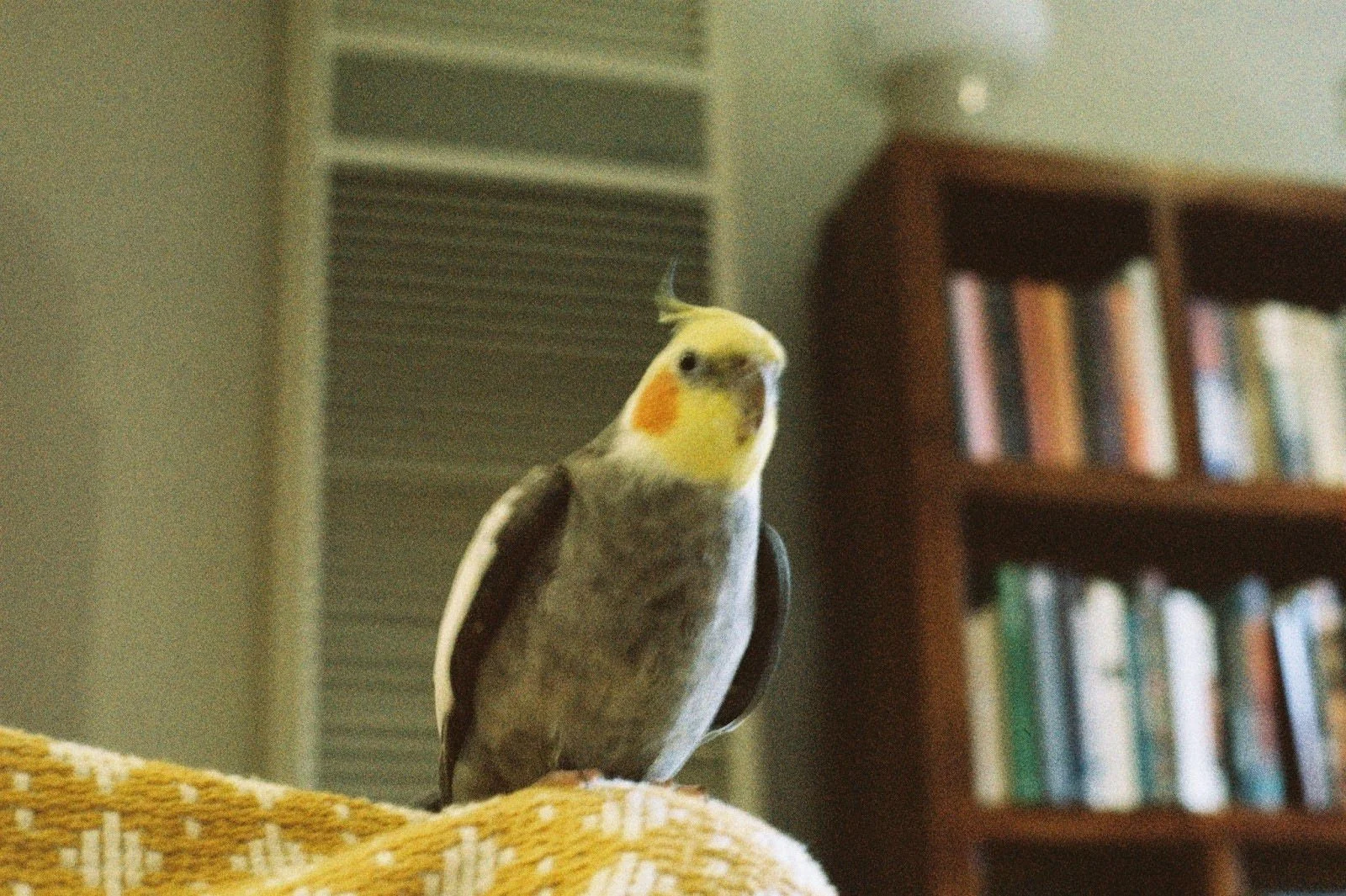
I love it when good friends come over to hang out with my birds. Some say they’ve never spent time with a domesticated bird outside a cage, or that their last avian interaction was scarpering from a swooping maggie. As we offer gentle scratches to my flock of three, our conversation begins to falter. We’re kind of mesmerised, parting downy feathers to reach their warm, sinewy necks that are thinner than our pinkie fingers. When my friends notice the birds’ ear holes, hidden behind the two perfect orange circles on the sides of their heads, they’re taken aback that they haven’t been stroking rosy, pinchable cheeks. While pats are accepted pretty quickly, no amount of whistling encouragement will get the birds to sing until they’ve properly sized up their unfamiliar visitor. Singing is something kept between them and the humans they choose to trust.
Oscar arrived at our house as a grumpy little bin-monster, hence the name. He’s a cockatiel of indeterminate age, corn-yellow with light grey streaks on his wings. His legs are long and skinny, sticking out from his belly like toothpicks. A woman found him behind the Dan Murphy’s skip bins on Albion Street, his life before that a mystery. After searching for his people for a few months, I let myself get used to the idea that he might join the household flock more permanently.
Though his demeanor has softened over time, Oscar still rarely makes a sound, and scurries away from human hands. He is unsteady on his feet and a clumsy, sporadic flier—his vet says she can feel a badly healed break in one of his wings. These factors suggest he’s an older bird, but it’s hard to specify an exact age without doing lots of invasive tests. He passes his days waddling around in a shallow plate of water, chewing bark, and snapping twigsinto head scratchers that reach the places he no longer can.
Oscar joined Saltine and Pepper, who came together in the same rag-tag hatch a few months earlier. They were rehomed to me still very young, yet to have their first big moult and get all their adult feathers. Unlike Oscar, I have photos of them as babies, the first quills of feathers poking through their fleshy pink skin. Their last human loved them, but she was a single mother of five who could no longer satiate their bottomless appetite for human attention. Her eldest child, who seemed to be mildly ornithophobic, dropped them off at my house at the beginning of last winter. While he was very happy to see the back of them, I still sometimes send his mum photos and recordings of the new songs they’ve learned.
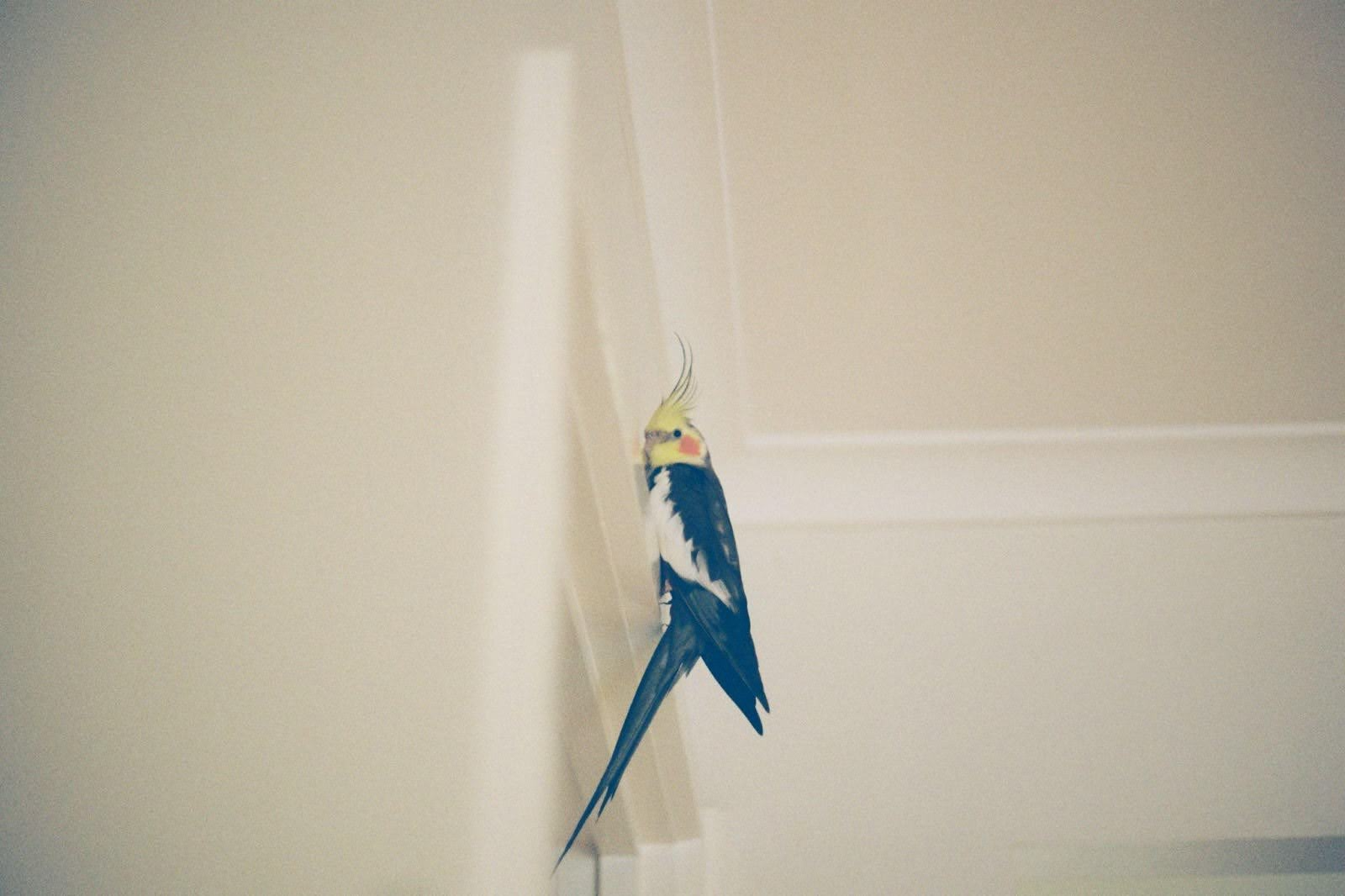
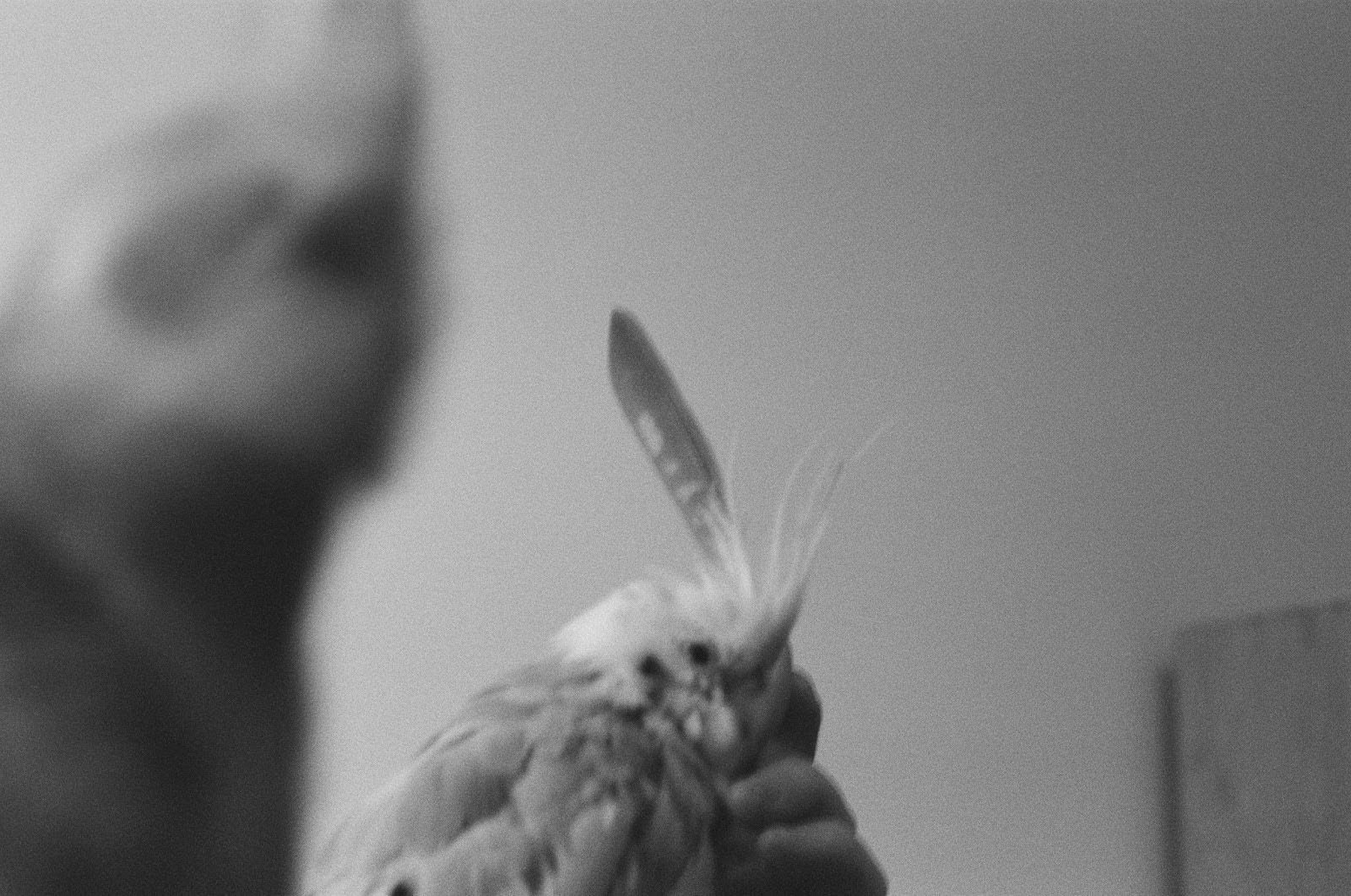
Pepper is the closest to a wild grey cockatiel of the flock—extremely handsome and he knows it. He wants to explore every inch of our home and taste the pages of every book I own. Saltine, meanwhile, is a whiteface cockatiel who would’ve been selectively bred over many generations to get the light fawn colouring on her flight and tail feathers. She was quite sick as a baby and not putting on weight, so I continued hand feeding for months after her anticipated weaning period. Her vet did some tests in an attempt to figure out what exactly was ‘wrong’ with Saltine early on, but we’ve given up on diagnostics at this point. She’s just a bit ragged, a bit squashed looking, a bit of a delightful little weirdo. When I’m reading on the couch, Saltine likes to fall asleep in my hand, bundled up against my chest. In these quiet hours, I roll her soft quills between my fingers, breaking apart their powdery keratin sheaths to reveal brand new, perfect feathers.
Saltine is the only bird in the flock who attempts human speech, babbling in undulating, raspy squawks that’re, honestly, kind of offensive to humankind. I can’t recognise any words except a quick, two-syllable ‘Pepper’ when she’s trying to get his attention. She’ll sit on my shoulder and just want to chat, will stop and give me time to respond, lean into my cheek and give me one click of a kiss. On those afternoons, when I assume she’s recounting her day, I don’t need to know what she’s saying to know that it’s important I take the time to listen to her.
Before I had birds, I lived in Aotearoa for a year and grew enamoured by the complex sounds tuis make. Tuis are a native songbird with darkly iridescent blue and green colouring with a few rounded, white feathers adorning their throats that fluff up, pulse and quiver while they sing. Early on in my time there, a tui would sit on the flowering flax in my backyard and drain it of nectar every morning. Later in the afternoon, I would hear five notes sung in a slow loop for hours. I think the progression fell within an F# major scale, but it wasn’t quite a match for the diatonic scales I’m familiar with. Quiet and mournful, the notes held a deep, enduring tone that gradually permeated the walls of my flat like rising damp. Though I never saw the tui make these sounds, I decided he must be the one singing this song that gently commanded the valley. I found out later that even if the culprit was another songbird, any tui could’ve easily learned to imitate the refrain if they wanted to.
Within each tui is an incredible vocal instrument. One tui can sound like two separate birds in a duet, made possible by two voice boxes—their syrinx—nestled inside their chests. Their range goes far beyond human hearing too, with melodies that soar through canopies, engineered to escape human ears. Maori culture celebrates them as sacred, spiritual animals, that have even been taught to speak te reo. If a Maori person is known to ‘have the throat of a tui’, they are considered a gifted singer or orator. The tui is honoured and beloved by the people who know them best. The half of their song I could hear was always enough to keep me listening in, head tilted towards the nearest branches.
Everywhere I went in Aotearoa, the tuis sounded different. In The Bird Way: A New Look at How Birds Talk, Work, Play, Parent and Think Jennifer Ackerman explains:
Tuis from the coastal town I lived in had the clicky-clacky crunch of a stick being dragged quickly across corrugated steel. Further south, in Wellington, their song sounded almost synthetic; a laser blaster in an old sci-fi film. At one of the southern-most points, on an island called Te Wharawhara, they were beat boxing, with acrobatic trills and clicks interrupting complex melodies. I traipsed around recording them on my Zoom, the audio tracks acting as fingerprints of places I like to retrace. They feel unreal to me now, sitting in my study late at night, with my birds roosting just behind me. I know they can hear the tuis though my headphones—they’re growing restless.
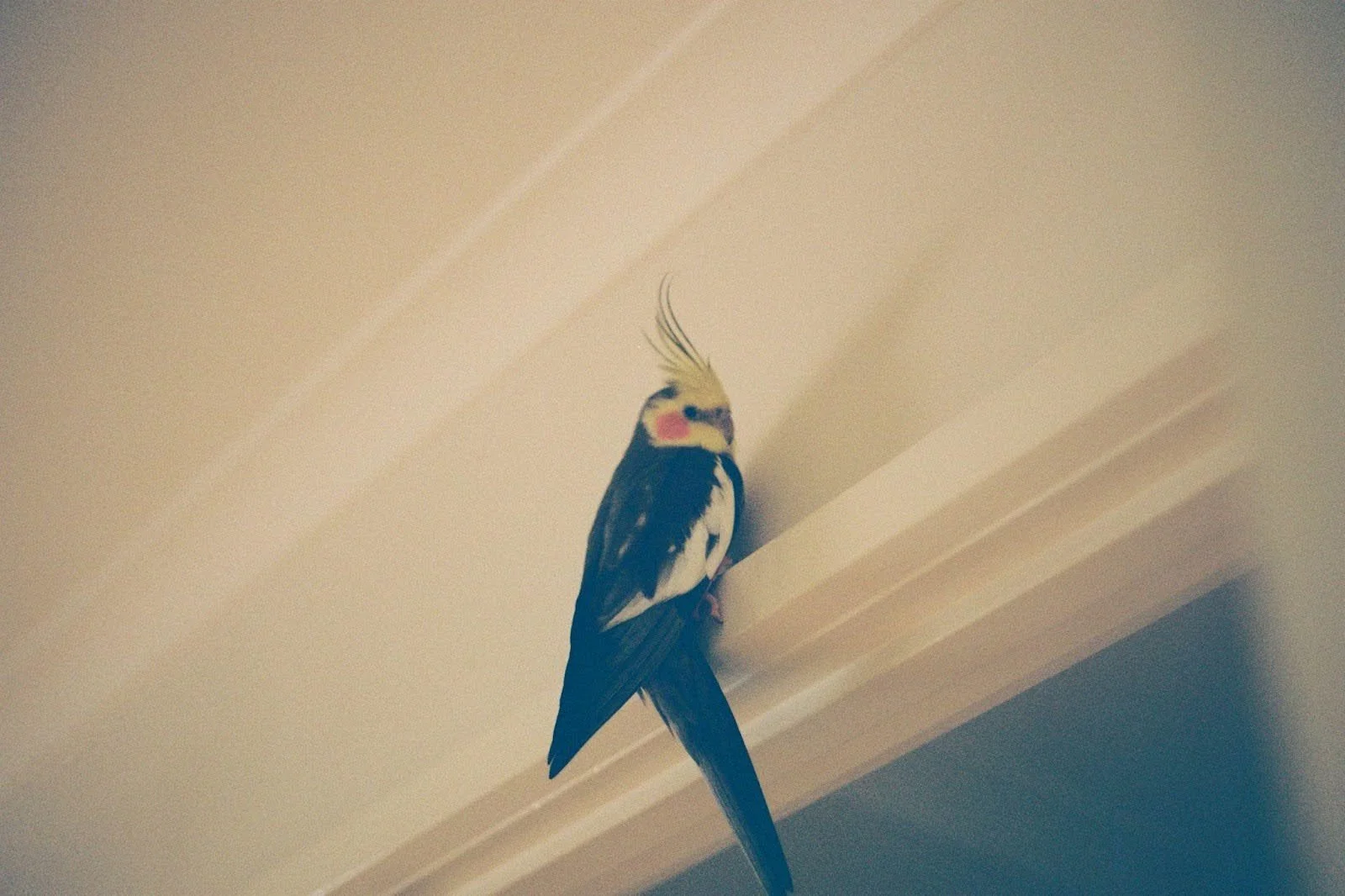
When Saltine and Pepper first arrived, they didn’t whistle any songs. They were too young, still filling into their tiny bodies. Instead, Pepper would mimic the high-pitched, rusted squeak of their old cage door opening. He’d do it every morning between me waking up and letting them out, a simple dialect formed between us. One morning last winter, I woke not to the cage door noise, but a feeble, faltering whistle. The birds were still roosting in the dim morning glow, in the study that has slowly and unceremoniously devolved into their room. As light started to sneak further along the walls, his fumbling notes became more recognisable. Pepper was practising the song I’d taught him.
‘If You’re Happy and You Know It’ is a tune that can be shortened to eleven notes and falls within a band of frequencies that cockatiel syrinx and human vocal cords overlap. Pepper has fallen into a routine now of whistling this song to me while I do the dishes, perched proudly on the still-warm faucet. After whistling the eleven notes, he waits for me to kiss his little beak twice—two claps for him. He ruffles his feathers happily above the steaming, sudsy water and starts again.
Saltine is more sonically adventurous and less interested in form. She learned the first eleven notes of ‘Jingle Bells’ last summer and has been playing around with the first four notes of ‘Old McDonald’ just this week. Most of all, she likes singing to others. She’s so earnest, gives direct eye contact, bobs along to the beat. Always in time, the melody an afterthought.
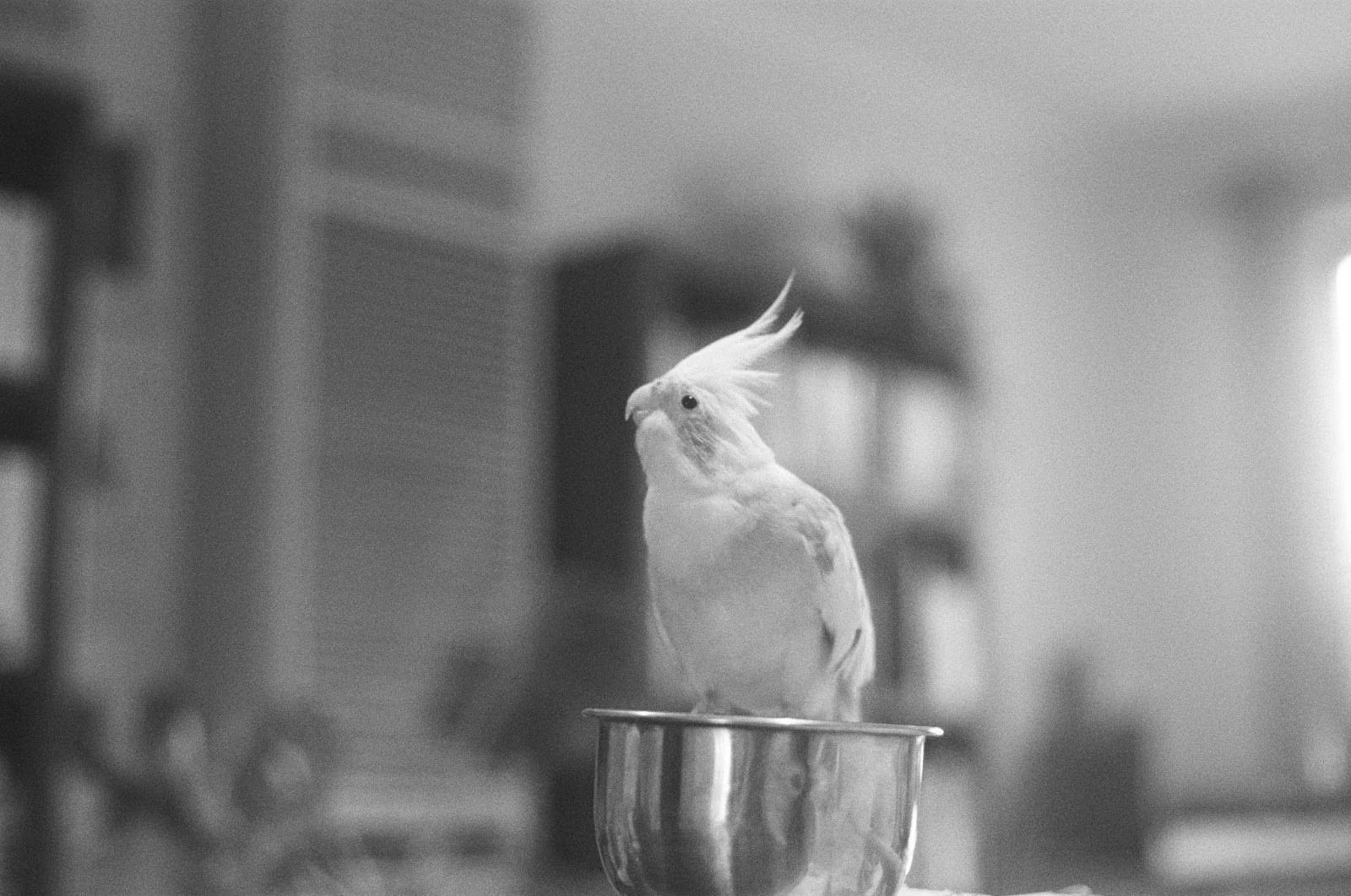
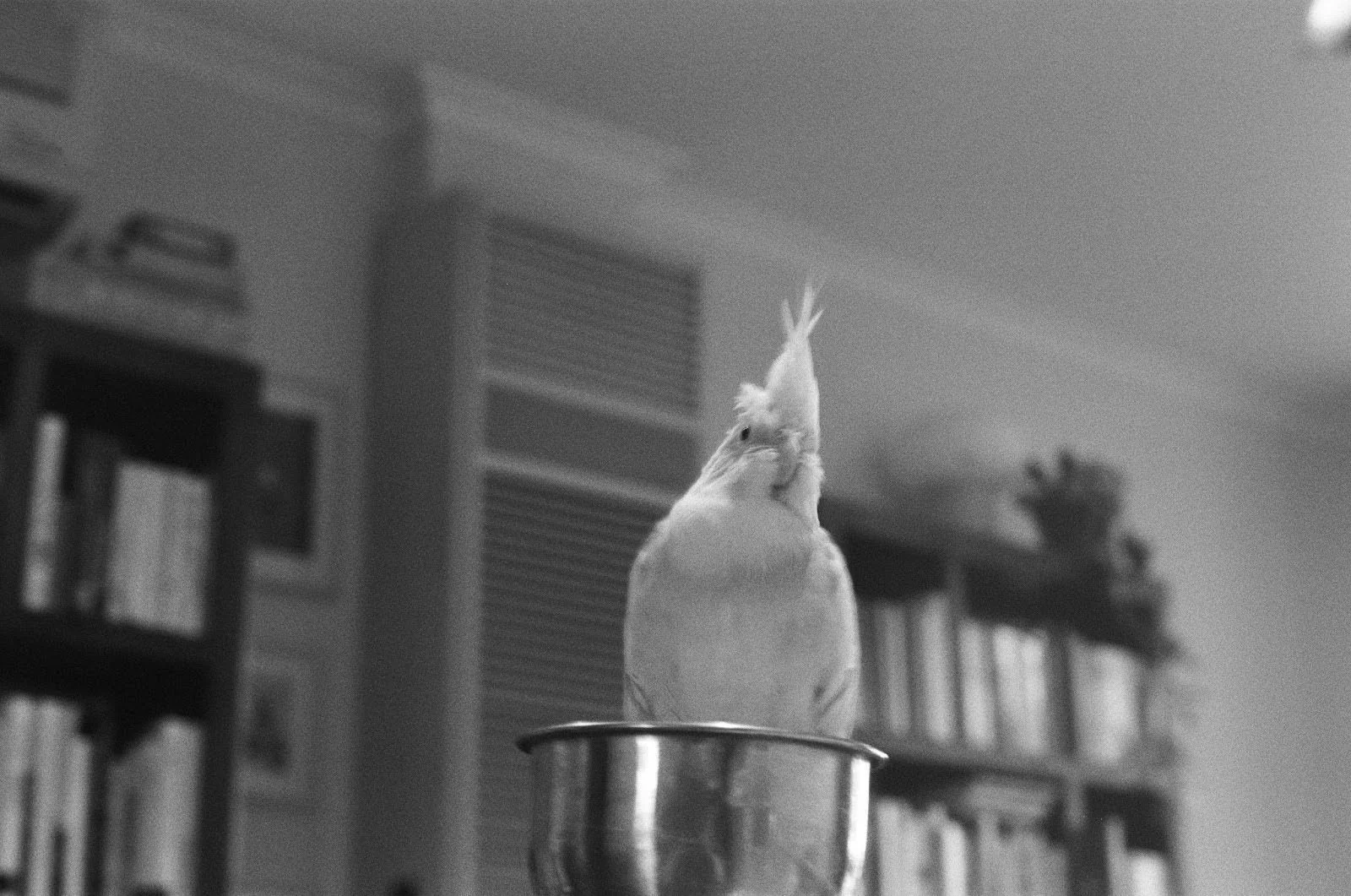
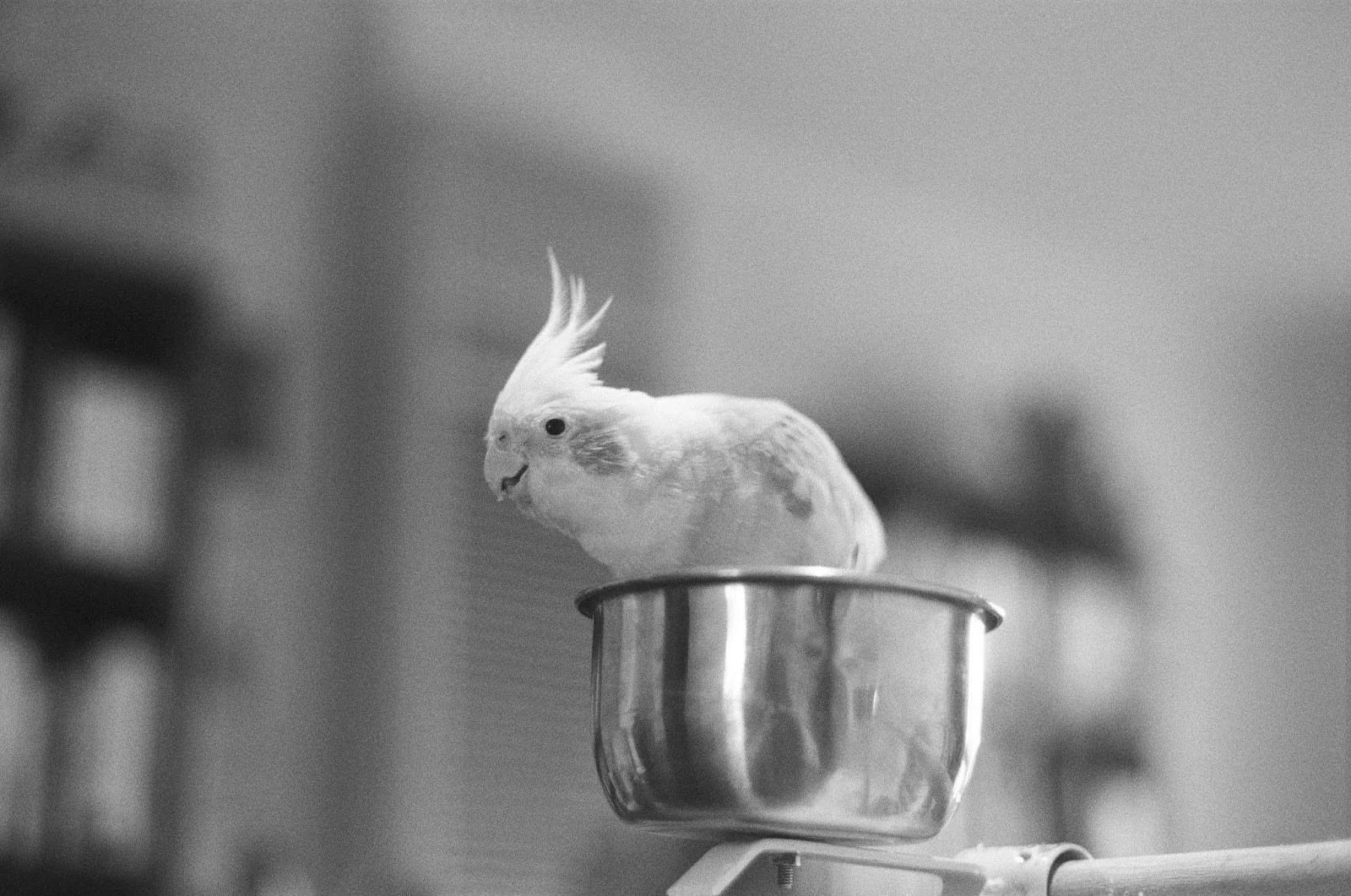
Oscar doesn’t sing but he flock calls, screeching desperately from rooms everyone has left. He hates to be left behind but struggles to keep up with the others, so my housemate Paige and I ferry him from room to room whilst he perches on a food bowl. Directing us in a game of interspecies charades, he leans his body to where he wants to go and reacts to our movements with chirps of either encouragement or irritation. I watch him sail around the house on his little metal boat, reaching his desired destination with fresh chewing opportunities.
Paige and I watched The Wild Parrots of Telegraph Hill earlier this year, a documentary following a man who cares for hundreds of wild conures who have taken up residence in San Francisco. The man is out of work, living in a cabin owned by a wealthy couple who have no use for it (yet), and has vowed not to cut his hair—that now trails down his back in a long, thin ponytail—until his next romantic relationship materialises. The conures, with their bright green bodies and flashy red heads, look wholly out of place amongst the earthy colours of this human and the sparrow-sized native birds from the area. They flock around the man and take sunflower seeds from his outstretched hands as he greets each one affectionately with names he’s bestowed.
I was sort of repelled by the long-haired man, in a way I felt ashamed about. Is that how outsiders see me—a loner with an avian fixation that occasionally leaves me with dried shit stuck in my hair and on my shoulders? I inadvertently made this proverbial featherbed and now I must lie in it until my cockatiels’ natural or untimely deaths? My morbid thoughts are interrupted when the conures spot a hawk and set off into the sky for safety in chaos and numbers, all screeching in the exact same way. ‘It even sounds like they’re saying hawk,’ Paige says from across the room. The long-haired man is left alone, squinting up into the sky.
I sent a message to my friend Alex, a bird-obsessive all her life, asking if she knew how and why birds sing together, even alongside humans. Do they enjoy it? She replied immediately, a barrage of links springing from her fingertips. One was a paper from 2021 that studied two young cockatiels in Tokyo who learned to sing along to a recording of The Mickey Mouse Club theme song:
the researcher explains.
The researcher concluded that the cockatiels could sing the song in time with the recording most likely because hearing the song activated the same place in their brain as if they were singing it themselves: a phenomenon called auditory-vocal mirroring.
In 2019, a group of ornithologists strapped microphones to and inserted neural transmitters into wild white-browed sparrow-weavers to study their duets and corresponding brain activity. The researchers found the brains of breeding pairs synchronise when they sing together. Their neural activity overlaps, the edges of each blurring until the difference between the two is negligible. Reading about this study made me think of that pleasurable feeling I get when singing along to the car radio, the way my brain can feel like it’s being stroked by the song; invisible fingers scratching an auditory itch between my ears.
I play the The Mickey Mouse Club theme song from YouTube to see what the birds do. Saltine starts singing along with her rendition of ‘If You’re Happy and You Know It’, bobbing her head along to the beat, stopping to wait for the two kisses from me. Pepper sits on my shoulder, looking between Saltine and I, feathers puffed up in displeasure at the discordant mess. I’m not disappointed in Saltine’s messy efforts though. The two cockatiels from the Tokyo study, named only C and PY, were kept in separate cages from 25 days old and never heard any other song than the one they were trained to sing. Pepper hops onto my desk to bully Saltine, and Paige ferries a screeching Oscar into the study on his metal boat. We share goofy smiles while our three rascals chew the corners of my journal and waddle over my keyboard.
A short film called The Great Silence is from the perspective of a parrot, who is narrating through subtitles across the screen. The parrot is contemplating their human neighbours building a giant telescope in their tropical forest home, hoping to make contact with extraterrestrial intelligence. ‘Their desire to make a connection is so strong that they’ve created an ear capable of hearing across the universe,’ they say. ‘But I and my fellow parrots are right here. Why aren’t they interested in listening to our voices?’ While I know not a single bird actively took part in the production of this experimental piece of cinema… the parrot has a point.
The more I read, learn and write about birds, the more fascinated I become with the rich and complex social lives that run parallel to ours, rarely overlapping, in branches just above our heads. Not listening to their song feels akin to ignoring the sky, never digging fingers into the earth—tragic oversights in our haste to be somewhere or something else. But we’re right here and so are they. I hope we earn their trust.
Xanthea O’Connor is an arts worker living in Naarm, after growing up in Boorloo. She just started knitting her way through the 52 Weeks of Socks patterns and plays synthesiser in a band called Billy Cart, amongst other musical collaborations. Xanthea graduated from RMIT’s Professional Writing and Editing program, and was a Melbourne Recital Centre Writer in Residence and a Glenfern Fellow in 2019.
Sources Cited
Ackerman, Jennifer. The Bird Way: A New Look at How Birds Talk, Work, Play, Parent, and Think. Melbourne: Scribe, 2020.
Artribune Tv. ‘Allora & Calzadilla (in collaboration with Ted Chiang), The Great Silence’. Vimeo. December 14, 2016.
Max Planck Institute for Ornithology. ‘The brains of birds synchronize when they sing duets. Max Planck Neuroscience’. June 12, 2019.
Seki, Yoshimasa. ‘Cockatiels sing human music in synchrony with a playback of the melody’. PLOS ONE, 16, e0256613.
Troup, Christina. ‘Small forest birds: Honeyeaters—Bellbirds and tūī. Te Ara: The Encyclopedia of New Zealand’. Retrieved August 1, 2025,
Visit Zealandia. ‘Tūī. Visit Zealandia – Wildlife – Birds’. Retrieved August 14, 2025.
Whaanga, Hēmi and Priscilla Wehi. ‘Māori Oral Tradition: Ancestral Sayings and Indigenous Knowledge’. Terralingua, Langscape Magazine. Originally published March 7, 2017. Last updated June 17, 2025.