
Staring at the Sun
I’ve always been drawn toward intensity. Saturation. ‘Full-on’ experiences.
I remember discovering the unique sharpness of scraping on a blackboard. It was harsh like other harsh things, but in a new, insistent, way. It was distinctly unlike the soft grinding of granite with which I am overfamiliar, having grown up in a house balanced on what is essentially a big rock (on the much bigger rock that we all grew up on). Granite makes sound through giving somehow, incorporating its own destruction as little pieces scrape off. Intimate; up close. Blackboards, by contrast, are strident: they push back and make the scraping or grinding thing vibrate intolerably. Shrieking rulers, fingernails in agony. The Silence of the Chalk (1991, Dir. Jonathan Demme). It was dangerous and magnetic. A kind of discombobulation-on-demand that I could neither forgo or endure.
Intensity
like brightness, flicker and colour. Through 2012–2018 I was
‘employed’ at an esoteric perception research facility in the basement of one of the more questionably rigorous
departments of my university. It was my dream job, which came with my own key and the overwhelming sense that I
was on the verge of something profound. I
had recently learned about
crossmodality through the of visual and auditory perception(s) of rhythm. This had triggered
something deep (latent)
within me: I was determined that I would explore the substance and boundaries of human experience.
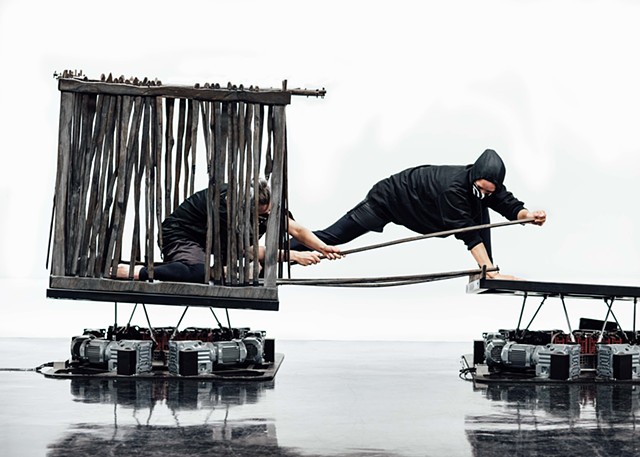
Our work in the Lab explored perceiving through a proprietary configuration of gaming PCs, audiovisual technology and robotic platforms±—we were writing music for your fingertips, eyeballs, and vestibular system.© Mostly I locked myself in the basement after class and stared into a projector lens, trying to see how colours were emitted and mixed in my eye (this is bad for your eyes).@ In retrospect I think I’d sought a niche that would allow me to follow my compulsions—chase intensity—in an uncritical, idiosyncratic and synthetic way that (crucially) nobody had warned me against.
Because really what I want to do all day is stare into the sun. It’s so good.
©
RMIT Gallery/Goethe-Institut: KLANGBEWEGUNG MASCHINE 'MERLE'
@
This essay is not about that work, though it was pretty interesting. We were creating what I truly think is a new kind of perceptual media—a kind of total body music—that is unfortunately too cumbersome for any kind of general distribution. I would call it sensory replacement (as opposed to the more popular sensory deprivation). Curious and intrepid readers are welcome to enquire further.
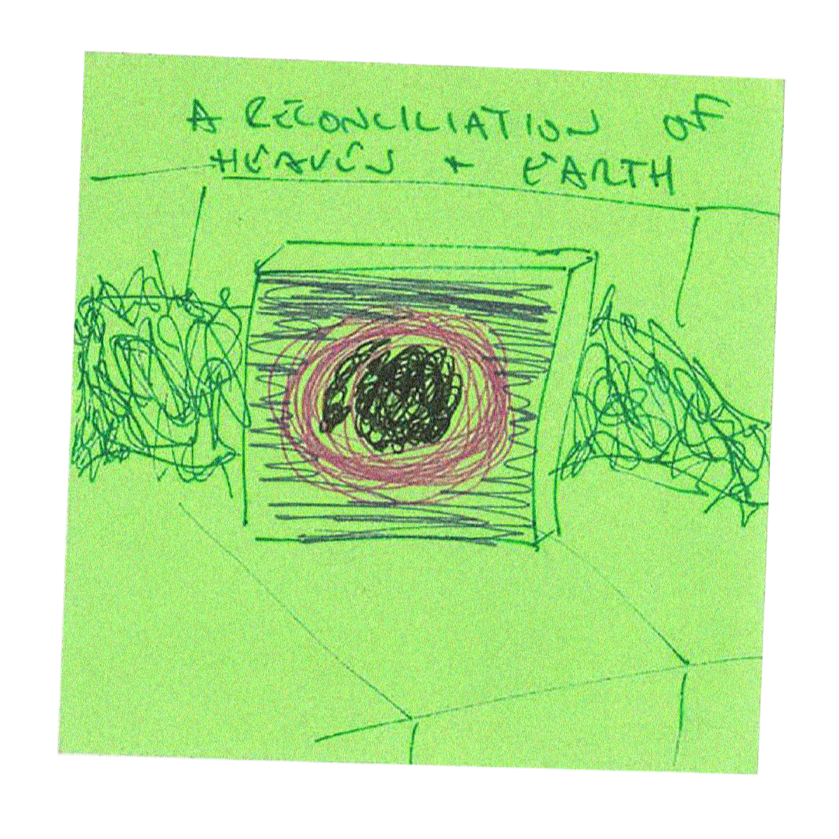
You are not supposed to do it, I guess. It’s pretty bad for you and apparently does make people blind.¤
I’ve stared into a lot of stuff, though, including an eclipse which tbh was both:
- beautiful, and
- totally fine, optically speaking (I assume; I’ve never seen an optometrist).
I would never recommend that you do it, but if you did you’d never see anything else like it. It was round. A bite out of the sky. The bright part was so dazzlingly bright and had a shape like one of those cartoon-y dinosaur feet (with the three toes). The dark part was a total void, but with dimension. It bulged like it wanted to throb. I was in year four, and once I’d had the idea to look I couldn’t not do it. There was ‘precognition’§ of my head turning and seeing (like, really seeing something) looping sluggishly in my brain. Each repetition was like muscle-will doing the thing for me until it happened, and I saw it (just for a moment), and I looked away. The sun-looking moved through me.
I’ve been told that staring at the sun is anarchic. Reading this might give you a romantic misapprehension about my motives: that staring is something volitional and cool, like really living, or breaking the rules, or something. I don’t think that’s what it’s about—it comes from somewhere else that is neither freewheeling, expansive or about face-to-face encounters with the world. I think it’s altogether more ‘icky’.
I believe that my staring (and listening, which we will come to) is tyrannical such that it is both volitional and compulsive. I have a ‘composer’s urge’ to take things out of time and fix them—either through maps or rules—into bounded and replicable sequences. An urge to find things about the world which make me want to be about them (in the sense of intentionality) and warp that aboutness into some kind of schema which can be communicated. Replicated, ideally, into some experiential form which serves as the impetus for an aboutness in others. In staring I am trying hard to impose order—organisation—onto a free and unfixed milieu. Trying to take the vastness of the sun and render it known.
Trying, and failing.
The sun is so good for staring because it is defiant to the last. It will burn itself (and my eyeballs) out long before it will grant me any genuine apprehension of its form, forming and doings. It’s the proto-disc against which all round, orbital and peripheral things can be measured. It is so wildly temporal (super-chaotic) and also somehow fixed into place (sub-chaotic), entirely without dichotomy. The sun’s nondichotomy (I’m talking about the coincidence of fixity and flux-ity here) seems to me emblematic of the essential quality of music, at least in terms of being a structure in time that we experience, but cannot quite hold. We remember its features, go through its movements, and even anticipate it intents, but though our apparatus for encounter is to take it in, we can never quite take it in. Our apprehension is somehow either sharply microscopic and now-ish; or blurry, out of time and global (vibes). In this sense music exists like landscapes (made through looking) do: stable, topological and recallable—but always tremulous. Changing, eroding, degrading, reforming and so on.
¤
Ingeborg Bachmann reads 'An die Sonne'
§
Philip K. Dick, 'The Minority Report', Fantastic Universe vol. 4, no. 6 (1956).
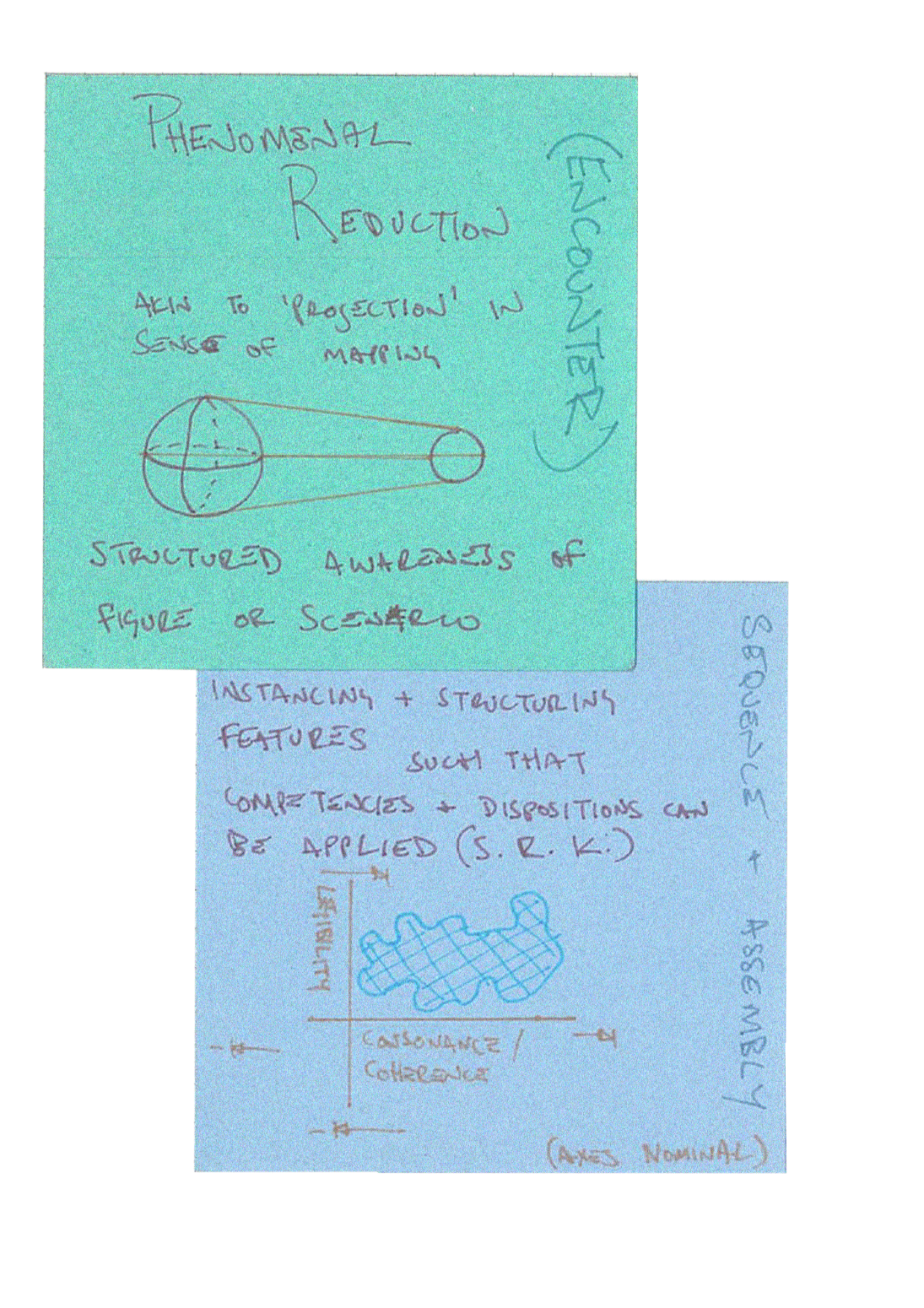
In music school we learned to think of music as being ‘organised sound’—it follows that composing is the ‘organising’. We also learned that organising happens as much at the point of audition (listening) as the points of conception (composition) and propagation (dispersion of sound e.g. through performance). This framework permits a broad gamut regarding what is or isn’t composition; in the simplest terms we accepted delineating points for starting and stopping Listening in a musical way as the fundamental music-making action. So, organisation is the definitive thing, and it happens in lots of different places. Leaky taps, bathroom fans, ticking clocks and so on can each be organised in the Listening way with (un)satisfying cadences, (interrupted) conclusions, texture, and dynamism—though one notes that I do struggle to whip up the enthusiasm I feel for such things in other people. Humans appear to be more compelled toward organisations which feel purposive somehow; musics which seem to contain some kind of communicable mental objects—understandings—that draw out of us recognitions of a kind of body-knowing that cannot be described or qual/quantified in another way. Things that have their own language for expression, which is music.
I learned this too slowly. Instead my ‘work’ agitated over spurious methods for organising sound which evoked this or that, explored here or there, or used some generative and stochastic such-and-suches to make music that could be parsed into a coherent, language-like thesis. Boring (I think) sound pieces, occupied with freezing ideas into forms in a completed, and not experiential, way. I was thinking about framing as opposed to perceiving, and using a collection of metaphors like ‘framing’ that either come from, or are better suited to, visual artmaking e.g. photography.
Music is more like the opposite of a photograph.
Photography is opportunistic and comes from structuring acts like freezing, capturing, imaging and distorting. Its contents are symbolically assembled in a flat way where frontmost things entirely eliminate those more backward. Entropy is uncannily halted (and in a sense undone)—the most desirable$ order-state of the thing-system is captured, frozen in time. Preserved, making photography an ideal medium for collectors, enthusiasts, fetishists, and other sickos who want to be microscopic and definitive in their appreciating.
Music, by contrast, is where order and structure go to die. It’s expressed, encountered, and explored through slippage. Even the most rigidly-organised Jacob Collier or JoJo Siwa–type pieces are ultimately experienced in strict temporality, subject to time’s immediacy and slipperiness. Compositions are forced to accumulate entropy, to dissipate and decohere through:
- the influx of new present musicalities
- the transit of current-present musicalities to a cumulative past
- the convolution of waveforms, whereby vibrations in a medium trend toward whatever ‘normal’ might be in a given system (e.g. gentle atmospheric eddies in an air-conditioned auditorium).
Photography is (in my uncharitable view) a method of sampling (as in data collecting; breakbeat chopping; #hex code finding; supermarket grape trying) that extracts life, snapshotting a milieu into organised perfection. Music does the opposite, giving in to living perfectly organised moments (memories, perhaps, or experiential curiosities), invariably causing their immediate passing. Organisation happens at the definitive moment of a photograph (click!), where music relies on pre-organised materials coming undone (more like pouring). One captures a performance; the other is expressed through performing. Where visual media parse-out into intelligible things (i.e. things for interpretation), music’s not like that, not really. The intellectual work of music-making is more like coding, or Rube-Goldberg arranging the initial and boundary conditions of a musical system. Music itself is in the coming-into-the-body (parsing-in), and good music comes into the body purposively. Is of the body, somehow, unleashes something dormant, latent, or bound within us.
Undeniable, like an earthquake.
Like other system-things that come from the world, musical experiences may be synthesised through composing or emerge through some natural or inductive processes. Rather than ‘organised sound’ (who does the organising, and when?), I prefer to think about music as a ‘bracketed system of tremors:’
- Bracketing in this sense tries to rearrange ‘organising’ and refers to setting conditions: sequences, agglomerations, parameters etc of temporal materials—sounds, and their behaviours.
- The system is about the weighting and interactions between things.
- Tremors because all temporal things are fluctuating and unfixed (sometimes rapidly, sometimes imperceptibly slowly) and all musical materials are emanations from some thing or other that trembles (e.g. strings, membranes, speaker drivers, larynxes, diaphragms, and so on).
$
In the sense of Krippendorff’s desirable futures.
*
The earbud is one arguable exception as the acoustic environment is local to the ear canal—sound can’t really do all that much in there. I’d suggest that listening to music on earbuds generally sounds ‘bad’—a diminished, low volition experience by virtue of limiting the body-inputs to the ear exclusively. We lose much of the context granted by our skin, inter-aural delays, sharing with others, and so on.
This loose definition folds into itself an important aspect about sound which is that it’s a bit dis-organised, really, isn’t it? We (composers, improvisers, etc) set conditions, thresholds, boundaries and what have you for sound-making, but ultimately sound does its own thing.* It wants to exist with all its energy, go as far as it can go, maybe even reflect upon itself, becoming convoluted& and warped. Like butterflies its lifespan is a short lived and necessary conclusion to its emanation into a world.
Music is this unique and strictly temporal thing which we do when we turn our apprehending-organs toward something tremulous—something that is incapable of fixing itself in either space or time. Music happens when we attend to things in a musical way:
- as in becoming sensitive to regular variation in pitch, timbre, and rhythm from an off-kilter bathroom fan;
- as in becoming sensitive to a 5-3-5-7-6-2-5 pattern (with variations on the theme) of intermittence in a decomposing sodium vapour streetlamp;
- as in the persistent (but strained) pendulum ticking of my beloved Kit-Cat Klock, who sadly does not count the hours but nonetheless disconcerts guests with its loud, barely regular incessance.
It’s very weird to me that we can even experience music at all. That musicality is so compelling to us, however, leads me to believe it emerges out of something we do that is fundamental to orienting ourselves in the world (sense-about, perceive, and interpret 3D space). We are sensitive to our surrounds in a way that enables reading them for causes, implications and most importantly intents, which are indices of other intentional beings. We read across our interpreting modalities to situate features in our milieu, and ourselves relative to those. Felled trees with torn or hewn divisions. Jumbles v. orderly piles. Generative, found or composed musics, text, images, etc.
&
‘Convolution is a mathematical procedure whereby one function is modified by another. Applied to audio, one of these functions might be a sound file or a stream of live audio whilst the other will be, what is referred to as, an impulse response file; this could actually just be another shorter sound file. The longer sound file or live audio stream will be modified by the impulse response so that the sound file will be imbued with certain qualities of the impulse response.’
–The Csound FLOSS Manual
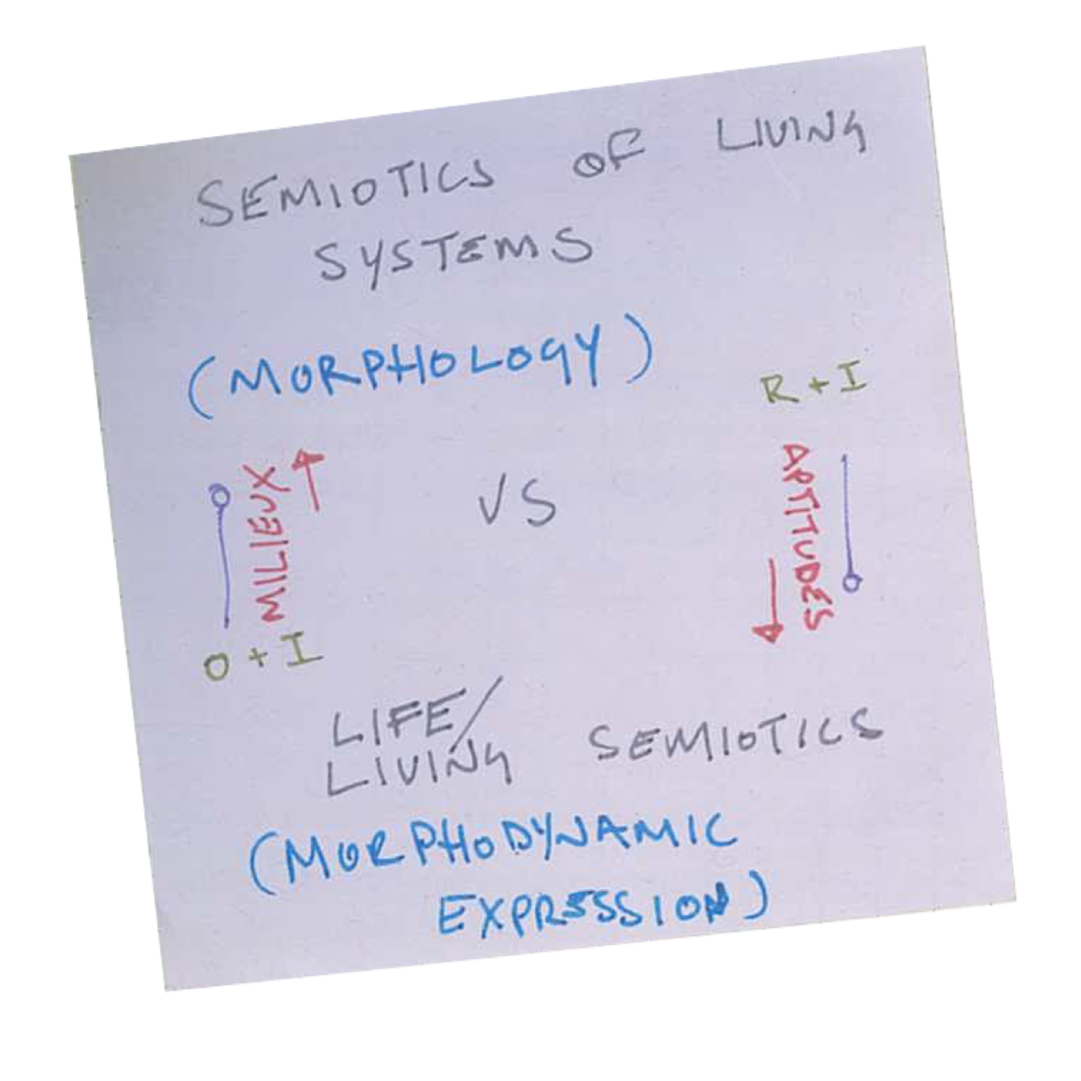
I think music excites us because its composition occurs through a series of organisings married to a collection of intents. After some rendering is done—glueing, or collecting, or editing sounds into a temporality— music expresses shadows or impressions of its intention through experience of its organisedness. Like imaging, composing comes from the ordering impulse, but it delights us because its outcomes grant us curious modalities for undoing itself. Musical listening lets us dis-order our world experience (which we seem to be compulsively ordering all the time)—perhaps through the singular focus it demands of us—and become trans- and sub-sumed rhythmically (in the surgings, if not in the ‘traditional’ sense of rhythm) through a warp in our perceiving. We can be ‘hypnotised’ into an immediacy-mode which feels electric and inevitable. It is maybe like a tiny dying which we get to do as a balm to our constant affect -making, -reading, -interpreting, -mediating homeostasis in which we transplant outsider-order in place of the traditional inputs to our self-worlds.¶
¶
‘To sum up Uexküll’s view, we can characterize an Umwelt as the subjective world of an organism, enveloping a perceptual world and an effector world, which is always part of the organism itself and a key component of nature, which is held together by functional cycles connecting different Umwelten.’
– The Biosemiotic Glossary Project: Umwelt
%
Loosely, but nonetheless consistent with Shannon’s formulation for a communication, which is very neatly summarised (slightly beyond my paygrade) here.
Ƹ
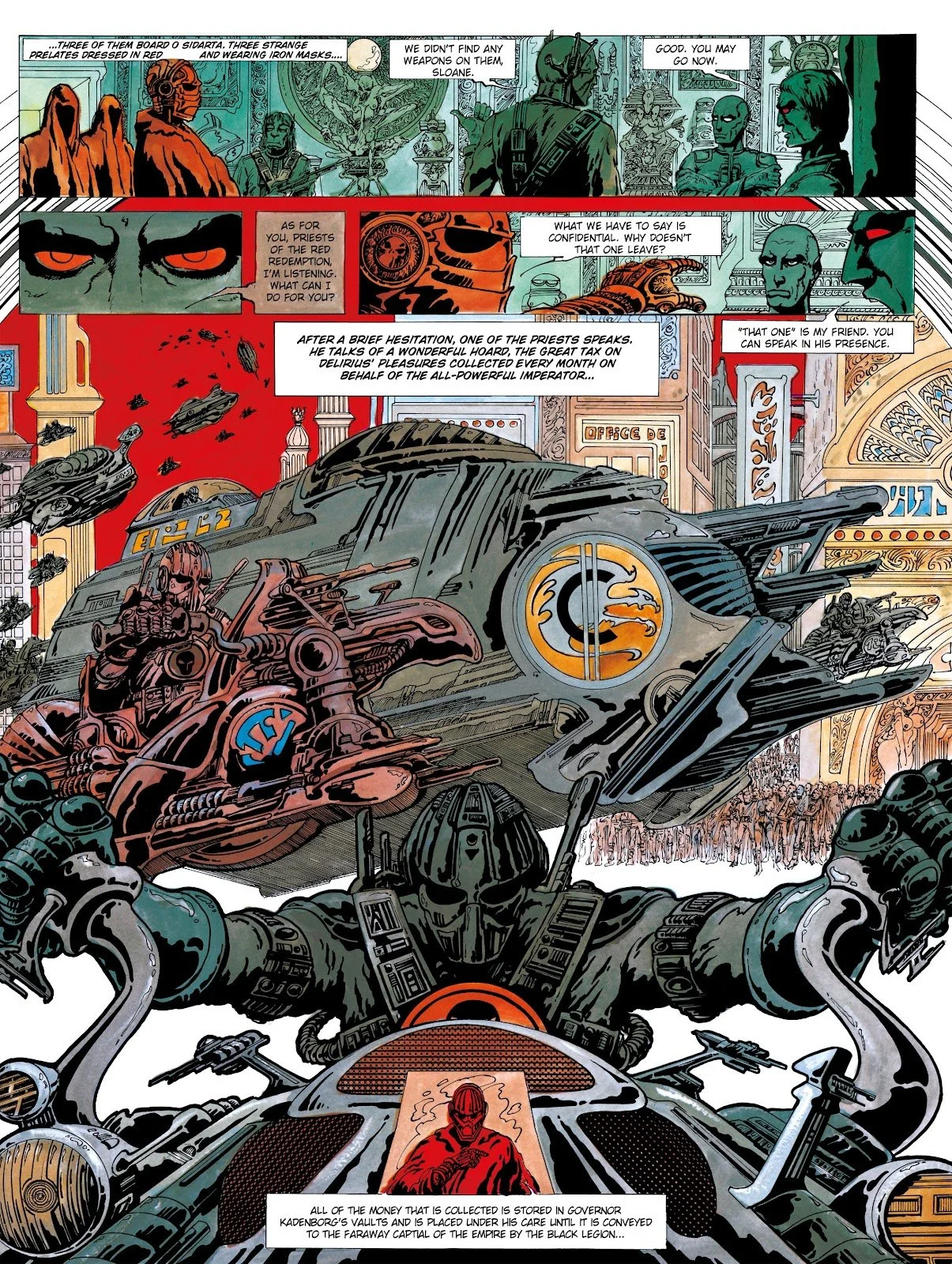
Philippe Druillet et al, Lone Sloan: Delirius (Titan Comics, 2021).
ᴙ
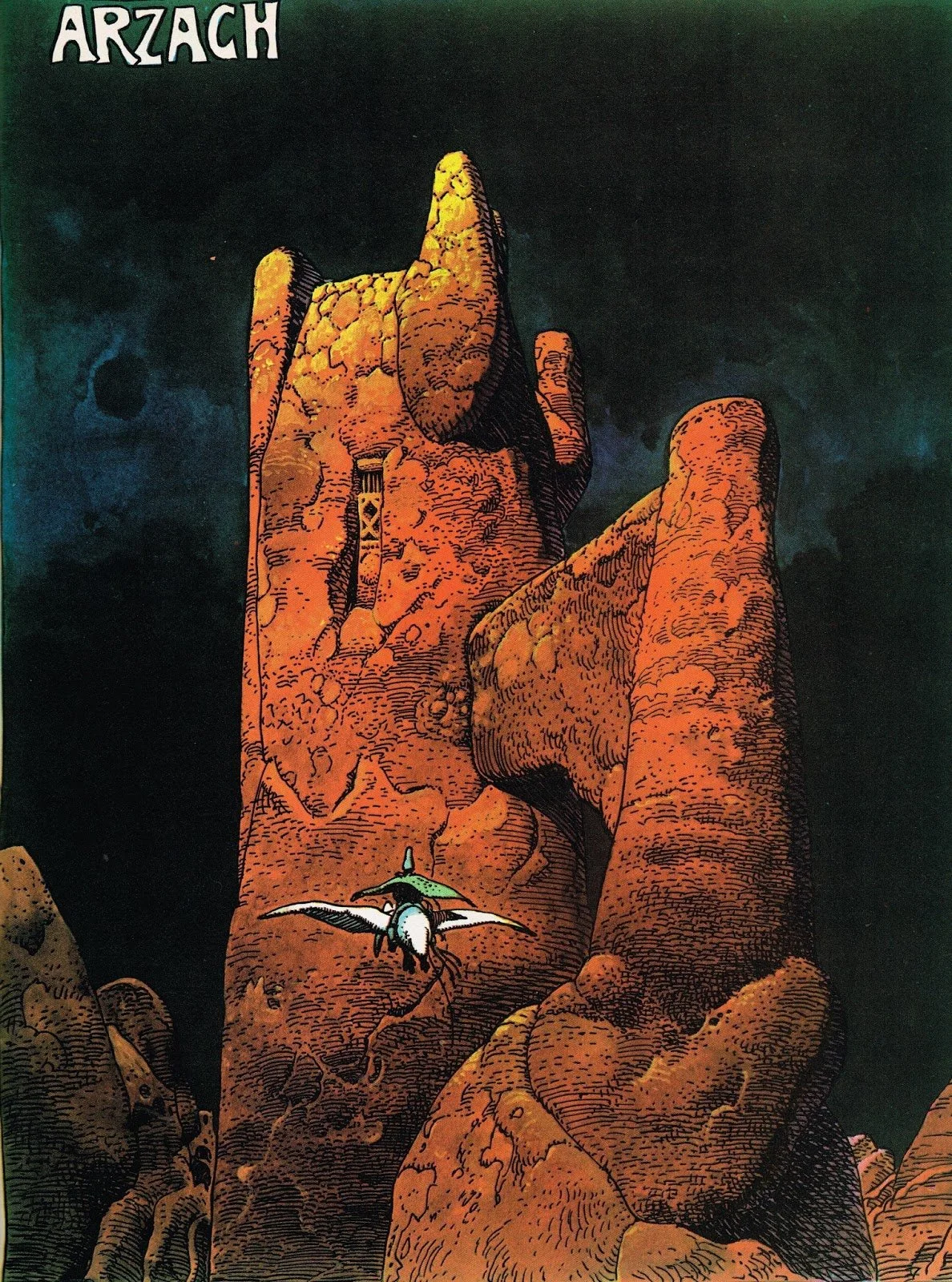
Mœbius, Arzach (Dark Horse Comics, 1996).
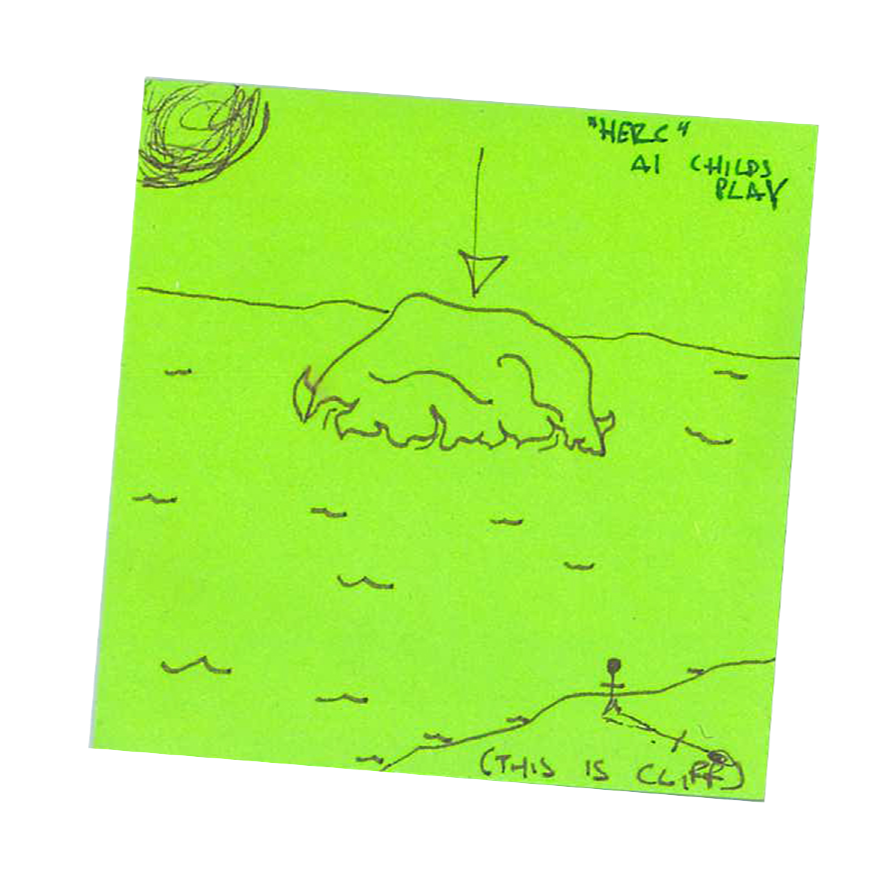
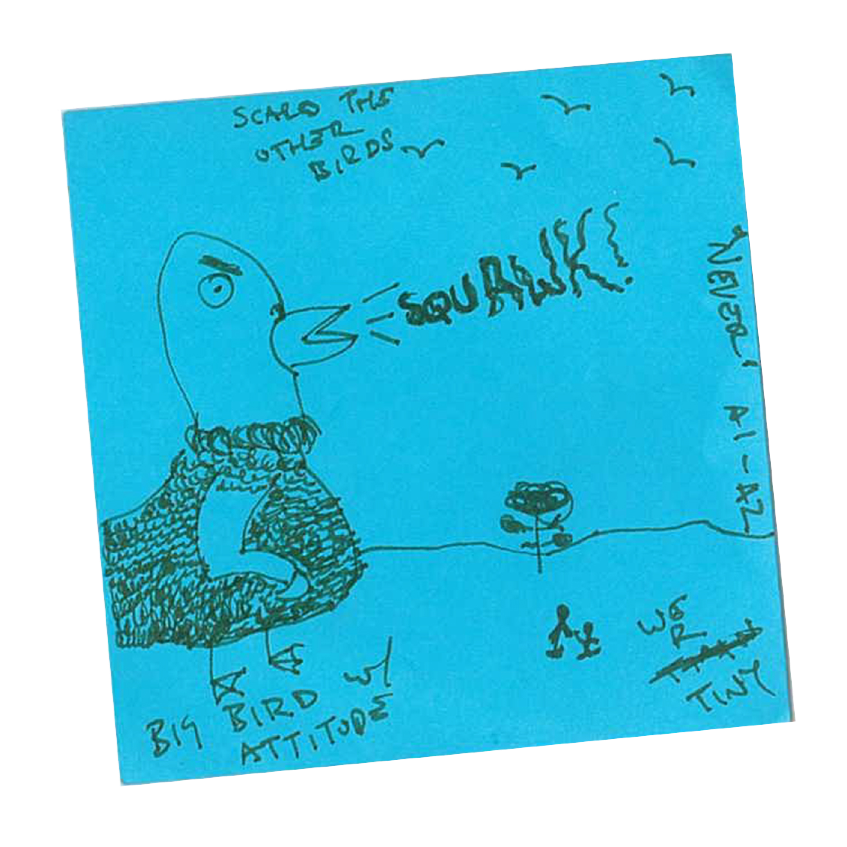
I’ve been drawing on a lot of sticky notes—things like ‘huge rock falls in ocean,’ or ‘big bird with attitude,’ which have some kind of rhyming body-feeling. Usually these are things to witness, or be present around. This is a crucial part of my ‘process’. Trying out different scenarios that contain a world-logic, something I’m trying to describe crossmodally, to draw-out or get-at something of what it is like to be. A description of being embedded within a world (embodied), played out as musical information from a listening-milieu.% Most of the time, in my soundtracks, this is about something that could be so vast (or an impetus in some other way) as to shred the world away—Ren and Stimpy™ style—revealing another, more-actual, scenario below it.Ƹ Or to think about a world creeping in (Arzach!-styleᴙ), or sharply intruding like the zonesƣ or the pyramid in Bilal’s Nikopol Trilogy.☨
I don’t think that music is supposed to ‘be like’ something else in the world: illustrate, describe or imitate worldly things (though it can and may do any of these); but things-in-the-world are often like music in their experiencing. Meaningful in a profound way that’s out of step or scale with the sundries of its composition—a way of recognising the patterns of things (and their comportment) that makes them tonal and that makes cadences of their temporality. Swarming birds afford our ignorance as well as transfixion; the composer (or performer) is charged with structuring experience/perception/impressions such that as many audients as possible turn themselves toward the musicality of a thing.
You can think of sound (and other temporal things) as these recursive systems of their own tremors. For sound—oscillation, vibration, transience, noise (in relation to signals) and so on—is all encapsulated as much by the harmonic series as by Boulez, and again in the performance of Boulez, and again in the listening (and so on, and so forth). Fractals. These are apprehensions of weird, behaviour-like epiphenomena around the relations of things: to each other, to being observed, and to you. In the memory of musicalised-moments past and the anticipation of new gestures is a profound and inarticulable sense of knowing that emerges only through the processes of having and experiencing musicality.
So this is what staring at the sun is all about: seeing-through seeing, into something unseeable. Brightnesses that don’t add together into a thing, but split apart into a description of your own perspective in real time. Apprehending that which defies apprehension, like trying to take in a piece of music with your brain, which is something only your body can do (and only if you agree to let it go immediately).
All of this is compelling to me because I really don’t see how and why an audience should be able to apprehend musical intents and yet they do in wild and multivariate ways. The only reasonable conclusion I can reach is that music reveals something innate, both about us and being (in a world); something curious that causes us to have a unique mode for expressing experiential body-knowing. A kind of knowing that we cannot use our feeble languages to describe, but that is—irrefutably—shared in all the same.
Music (like the sun) is the best.
ƣ
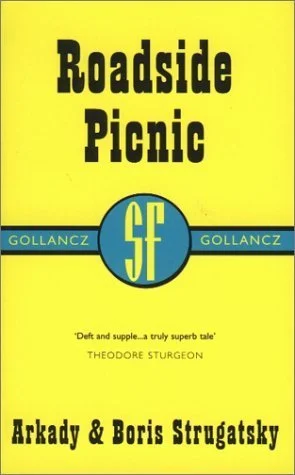
Arkady and Boris Strugatsky, Roadside Picnic (Gollancz, 2000).
☨
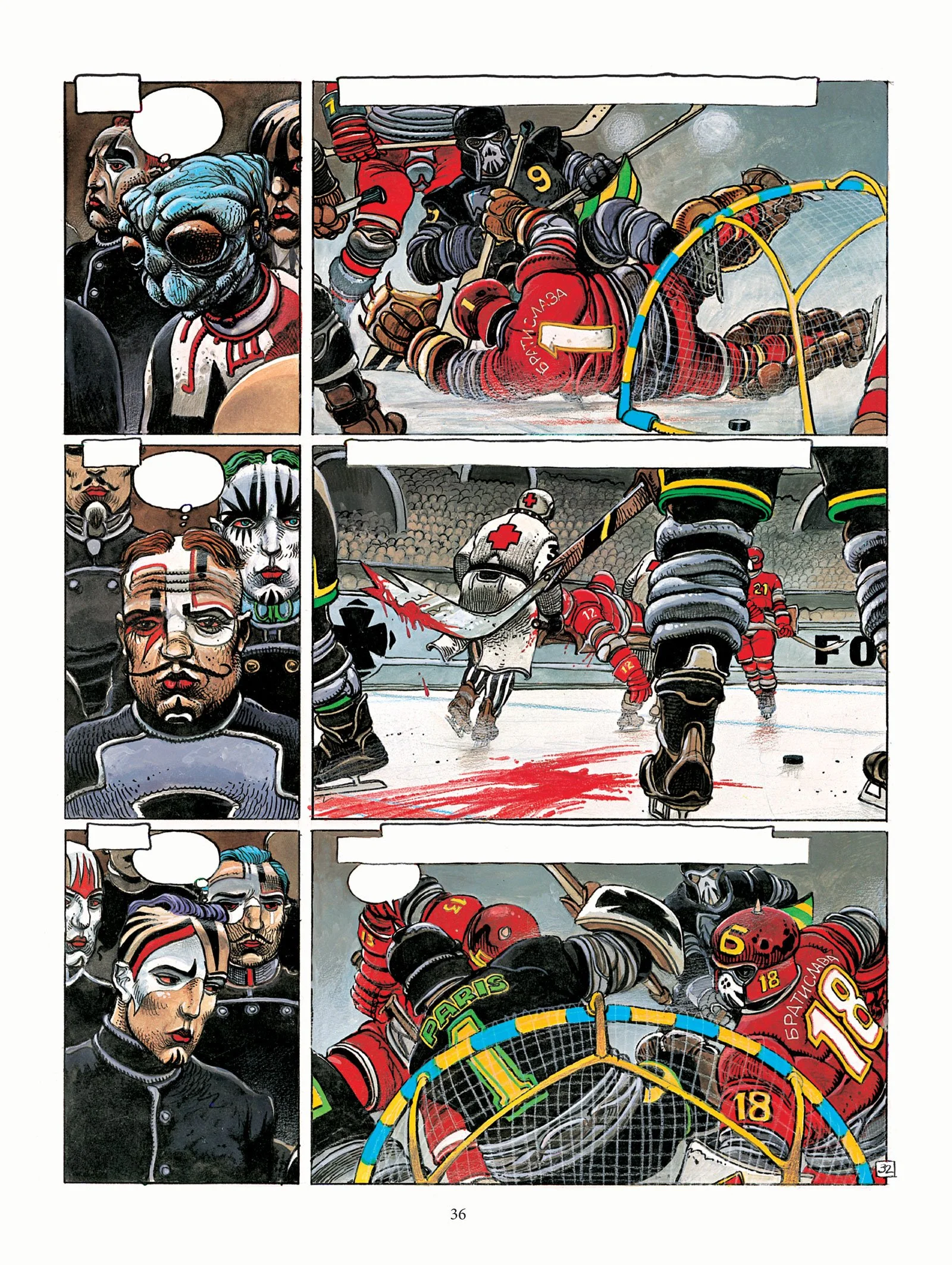
Enki Bilal, The Nikopol Trilogy: The Carnival of Immortals, The Woman Trap, Equator Cold (Humanoids Publishing, 1999).
HEAR WHAT IT'S LIKE TO STARE AT THE SUN. . .
James Paul is a composer and designer of digital media. Their work explores amplification, intensity and perception through abstract and chaotic virtual environments that feel like unsettling dreams. James makes sound, video and technical systems for artforms of all kinds. Their installation, exhibition and performance works lurk in institutions nationally. James is neck deep in a PhD.
Find a full list of sources here.