
Nature’s Active Voice // A Field Report From Plumwood Mountain
In re-animating, we become open to hearing sound as voice, seeing movement as action, adaptation as intelligence and dialogue, coincidence and chaos as the creativity of matter
—Val Plumwood, ‘Nature in the Active Voice’
On Sunday the 13th of October of 2024, Sammy and I came to Plumwood Mountain to run a workshop called ‘Active Listening’ with assistance from artist Broni Sargeson and Plumwood caretakers Ruby Kammoora and Clancy Walker. Our day-long workshop combined active listening, microphone-enabled listening to soil and water, walking, and group chromatogram fabrication. We borrowed the term active listening from Bird Rose’s eulogical article on Plumwood, wherein she describes active listening as ‘the work participants engage in as they inter-act with other sentient creatures’. For a practical guide to active listening, we used techniques from Deep Listening composer Pauline Oliveros, adapting her teaching of active engagement with the sonic environment. We adopted the chromatogram from soil science: as Sammy told me, ‘chromatogram’ means writing in colour. It’s an old process whereby a solution of soil or other organic matter is mixed with silver nitrate and allowed to steep over a small circular piece of blotter paper. For Sammy, these chromatograms are the visual expression of vibrant matter.

Over the course of a few months, Sammy and I discussed how to attune participants’ senses toward nature’s voicing. Participants were required to prepare by reading Plumwood's work, as well as the work by Deborah Bird Rose that contextualised it. Sammy would also introduce participants to Oliveros’ global and focal attention: listening as diffusely and environmentally as possible, and listening as specifically as possible, respectively. We would practise this global and focal active listening as a group. Through guided listening, we hoped to invite participants away from the normal (and understandable) temptation to chat amongst the human, and to turn their attention toward the birds, the frogs, the rustle of the plants, the movement of the water, the hum of the insects.

The night of the landback celebration, the cicadas came out in force. Ruby described sitting outside and hearing the soil start to crackle and wriggle, as thousands of bodies simultaneously slid out of it, their seven-year larval cycle over. Once out of the ground, they ascended to plumwood trees, where their shells split open and, with the help of gravity, their fresh new bodies emerged. We arrived ready to set up on the evening of October 12th. Plumwood was hallow with cicada shells: hundreds climbing up one tree, settling on bricks, nestling into orchids. Our workshop was to follow five distinct parts: listening while walking into Plumwood Mountain, the Oliveros-inspired active listening exercise, listening to microphones buried throughout the grounds, the making of a chromatogram, the sitting and talking together. In preparation for our workshop, Sammy and I walked the Plumwood grounds in the morning, as the mist was rising and the cicadas were just waking up. We placed microphones around the land, in places where nature’s active voice felt rich: a microphone in Val’s compost; a microphone in the in-ground pool for aquatic life near her homestead; a microphone under the plumwood tree behind the homestead; and then, fifteen minutes downhill to the plumwood grove, a microphone under a big, thick plumwood tree; another under the nearby fern; another in the stream running through the grove.

Plumwood’s writing on nature’s active voice is intertwined with her work on being prey, on the idea that we humans too are ‘part of the feast’. This was inspired in part by her own experience of nearly being eaten by a saltwater crocodile. Both concepts remind us that we are part of the more-than-human world, that communicates with us just as we communicate with it, that will consume us just as we consume it. In her article on being prey, Plumwood criticises Western human taboos around death and reluctance to admit that we are part of the food chain: ‘we may daily consume other animals by the billions, but we ourselves cannot be food for worms’. This dovetails sweetly with Olivieros’ active listening article ‘The Earth Worm Also Sings’: ‘my earth body returns to hers/where the earth worm also sings’ . Our workshop participants particularly enjoyed listening to the earthworms singing in Plumwood’s compost.

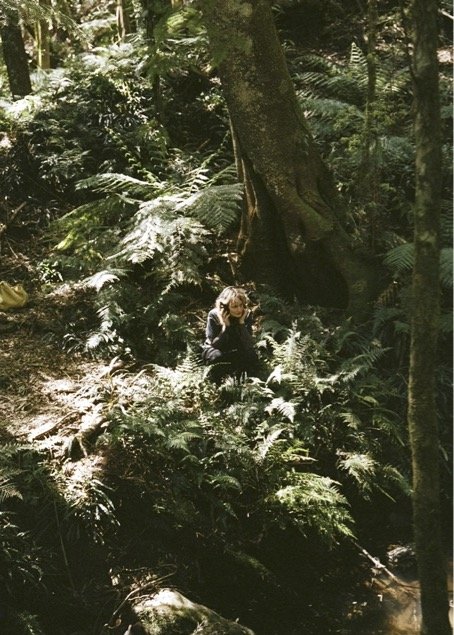
The walk between the homestead and the plumwood grove was a slow fifteen minutes in thick midday heat. We had asked participants to be silent as they descended. Somehow, all twenty people honoured our request. Brushing off crunching cicada shells. Hearing only our own footsteps and the call of the cicadas until, slowly, the babble of the creek wove its whisper in. The grove has a consecrated feel to it. You descend into a basin, surrounded by the entanglements of ferns and plumwood trees. Participants soon found their way to the microphones we’d placed in the water and among the roots of plants.
Down in the plumwood grove, reverent listening quickly gave way to play. Listening to water is a noisy, immersive experience. Participants who had previously listened at a respectful remove inserted themselves into the conversation: playing with the river, diverting its flow, creating rhythmic percussion on the water’s surface. Twenty metres away, listening to the microphone at the base of a plumwood tree, I heard their compositions, the sounds of the creek moving through the soil.

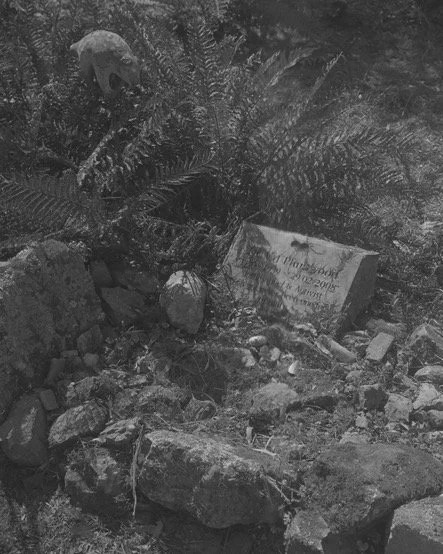
Early evening. The participants had gone, the sun had begun to set, and the cicadas had softened to a persistent chorus. Sammy, Broni and I sat next to Plumwood’s grave. We asked the grave for permission to record it, and we felt a pull towards the stones at its border. I slipped two contact mics into the edges, where the stones met the soil. And there, loud as thought, crackling. Movement. We listened for five minutes to the crackings and rumblings of life in that grave. Was it feasting or singing?
Sophia Dacy-Cole lives and works rurally, on unceded Ngunawal Country. She is a recent PhD graduate, an emerging Environmental Humanities Scholar, an artist, a writer, and an unschooled ethnoecologist. Her work centres coming home to the more-than-human world through deep sensory immersion, decolonial action and relationality.
Sammy Hawker is a visual artist working predominantly on Ngunawal / Ngunnawal / Ngambri Country [Canberra Region, ACT]. Through practices of reciprocity (facilitated acts of co-creation), Sammy's works explore the potential of interspecies dialogue, giving voice to the presences of more-than human worlds. These works reflect on how knowledge and memory is inscribed within materials, spaces and bodies.

Souces Cited
Bird Rose, Deborah. ‘Val Plumwood’s Philosophical Animism: Attentive Interactions in the Sentient World.’ Environmental Humanities 3, no. 1 (May 1, 2013): 93–109.
Hawker, Sammy, Sophia Dacy-Cole, Ruby Kammoora, Clancy Walker and Broni Sargeson. ‘Active Listening Workshop: Plumwood Mountain.’ Accessed February 3, 2025.
McDonald, Alasdair. ‘Walbunja Traditional Custodians Gifted Estate of Activist, Academic Val Plumwood in NSW.’ ABC News, September 23, 2024.
Oliveros, Pauline. Deep Listening: A Composer’s Sound Practice. iUniverse, 2005.
———. ‘The Earth Worm Also Sings: A Composer’s Practice of Deep Listening.’ Leonardo Music Journal 3 (1993): 35–38.
Plumwood, Val. ‘Being Prey.’ Terra Nova 1, no. 3 (1996): 32–44.
———. ‘Nature in the Active Voice.’ Australian Humanities Review, no. 46 (2009).
Plumwood, Val, and Lorraine Shannon. The Eye of the Crocodile. ANU Press, 2012.