
heartsound (意)
arranged for electronics, imagined saxophone quartet & reader
0'00"–0'00"
Dear Reader. You are a performer. Your performance takes place in your imagination. You are
accompanied by an electronic track accessible below. This is a duet between real sound (the
electronic track) and imagined sound: the saxophone quartet, and the memories you’ll make
real as you read, and perform, in your mind.
Sometimes music doesn’t begin with music, but with silence, or with imagined sound from another world. Imagine a saxophone quartet on a dark stage. Glints of gold in shadow. Your mind drifts. You remember when you were fifteen, learning to play ‘Clair de Lune’, afraid of the opening notes that must be played delicately and quietly, con sordina. You hear rustling from the audience that waits for you to begin, and your shoulders stiffen. Breathe first. Your piano teacher would gesture to the quaver rest that opens the left hand; the anacrusis; the upbeat of silence.
Sometimes music doesn’t begin with music, but with silence, or with imagined sound from another world. Imagine a saxophone quartet on a dark stage. Glints of gold in shadow. Your mind drifts. You remember when you were fifteen, learning to play ‘Clair de Lune’, afraid of the opening notes that must be played delicately and quietly, con sordina. You hear rustling from the audience that waits for you to begin, and your shoulders stiffen. Breathe first. Your piano teacher would gesture to the quaver rest that opens the left hand; the anacrusis; the upbeat of silence.
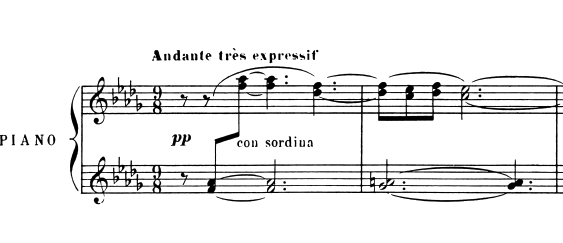
‘Clair de Lune’ begins not with music, but with a quaver rest that
almost looks like a comma, as if caught mid-sentence. Listen from within the anacrusis.
Do you hear distant carnival music? The clumsy footsteps of Bergamo townsfolk dancing the
bygone Bergamasque? There can’t be moonlight without the sun first setting like dark pink
wine, the whiskey-warmth of fruit and flames, a young flautist playing a pastoral tune
into the wind… All this before even the first note of music! Inside the anacrusis must be
an entire world. The pianist doesn’t begin, but joins in with a melody from this
other world that the audience can’t hear but can somehow feel. This other world exists
secretly within the heart of every piece of music; the labour, history, rehearsal and memory
beneath the performance. Speaking of, the piece you are about to perform, heartsound (意),
comes from the word for meaning in Chinese, 意, which comes from the characters for
sound, 音, and heart, 心. This performance occurs within the other world; the
secret heart of an anacrusis. The audience is growing restless.
Are you ready? Hover your cursor over the track. Press play. Begin.
Are you ready? Hover your cursor over the track. Press play. Begin.
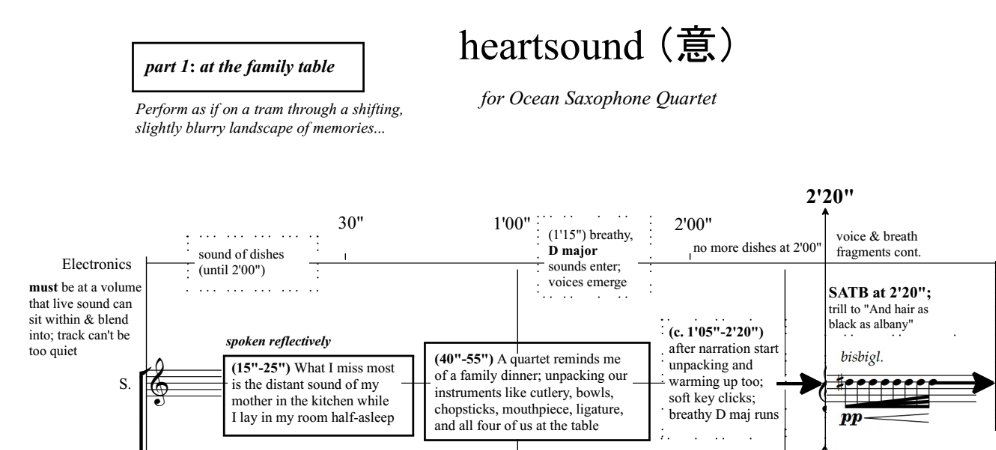
0'00"
part 1: at the family table (0'00"–3'00")
The imagined saxophone quartet begins to unpack their instruments, the clicks of gold and brass merging with the sound of dishes.
The imagined saxophone quartet begins to unpack their instruments, the clicks of gold and brass merging with the sound of dishes.
0'15"–0'25"
A voice from the quartet narrates, lucidly (if you like, narrate
aloud too!): ‘What I miss most is the distant sound of my mother in the kitchen while I
lay in my room half-asleep’. When you were a child, you were afraid of sleeping alone.
You would leave your bedroom door open just a little to let in the light and voices from the
next room.
0'40"–0'55"
The narrator continues: ‘A quartet reminds me of a family dinner; unpacking our
instruments like cutlery, bowls, chopsticks, mouthpiece, ligature, and all four of us at
the table’. During rehearsal, the tenor saxophonist joked about placing a lazy susan amidst
the music stands, or pulling out a pair of chopsticks from his saxophone case. But now, all
four players concentrate in unison, warming up softly, like an orchestra before first
applause. (If you are a fast reader, take a breath here, and elsewhere, as needed.)
1'15"
Breaths emerge like memories. A child and mother’s voice flickers with mothbitten words. You think of how a saxophone is a bit like a conch shell, warping air into ocean-noise, into music. The breaths from saxophone, child and mother blur until you can’t tell one from the other.
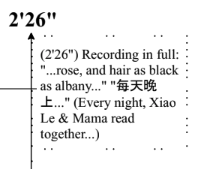
2'26"
You realise the child is mispronouncing ebony from Snow White and the Seven Dwarves: ‘And
hair as black as albany…’ As the child reads in English, the mother narrates over the top
in Mandarin. The child begins to whisper, little tendrils of smoke-sound interlocking with
the mother’s voice: ‘每天晚上,小乐会跟妈吗做reading…老师说小乐的reading和写作做的很好呢’ (Every
night Xiao Le and Mama read together… The teachers at school say that Xiao Le is doing very
well in reading and writing).
Every night, after reading together, the child selects a shiny princess sticker to place on
their bedroom door, right on the wood, so that even now the stickers are there, impossible
to claw off after all these years (can you see the stickers shimmering, now and then, in the
light reflected off the brass and gold saxophones?). The recording ends with a high-pitched
beep from a fire alarm battery that needs changing, needed changing, a decade and a half ago…
part 2: trams & clocks (3'00"–6'25")
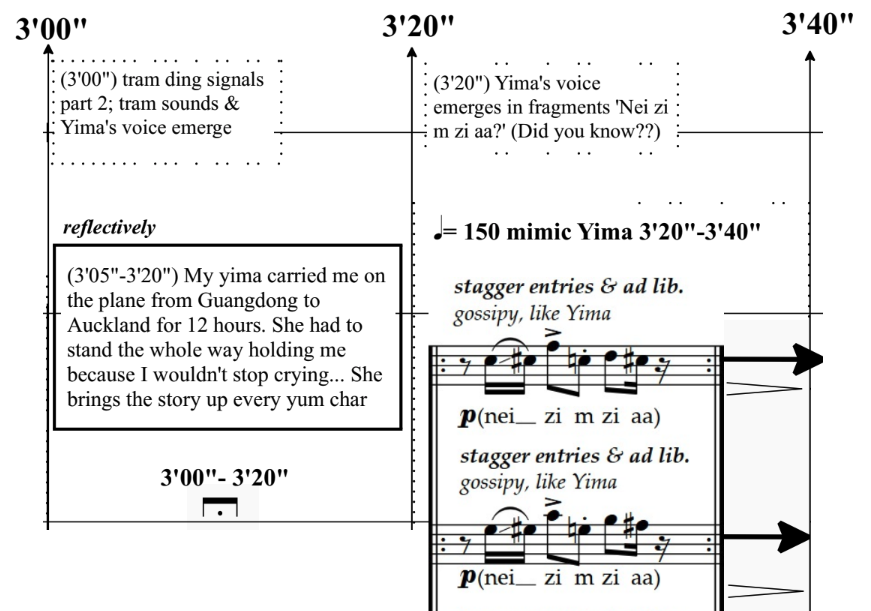
3'00"
DING! Is that a tram bell? Where are you now?
3'05"–3'20"
The narrator speaks again: ‘My yima carried me on the plane from Guangdong to Auckland for
twelve hours. She had to stand the whole way holding me because I wouldn’t stop crying… She
brings the story up every yum cha.’
3'20"–3'40"
Now the saxophone quartet erupts like ducks mimicking Yima’s percussive Cantonese, ‘Sap ji
gok zung!’ (Twelve hours!). The child used to be afraid of Yima’s loud voice that always
sounded angry, until they realised Yima’s laughter was even louder!
3'40"–3'55"
A familiar clock tower’s chime emerges as the narrator continues: ‘Later, I boarded the
plane alone to Melbourne for university where I live now, the sound of tram bells merging
with chimes from the Melbourne Central Clock.’
4'00"–4'17"
Is that Yima again? Listen closely. She says people on the plane tried to give the child
chocolates, but the child still wouldn’t stop crying! (4'16": and is that a tram announcement
for Stop 40?).
4'30"
‘You were about two,’ says Yima in Cantonese, ‘Oh, I will never forget it my entire
life!’
4'45"
As the saxophones swirl with the clock tower tune in legato, smoothly, the mother’s voice returns in Mandarin, ‘...I had to take exams as well as look after Xiao Le, and every night at midnight Xiao Le would cry.’ (4'50": ‘The next stop is Wilkinson Street!’)
5'05"–5'35"
The saxophones fade into the tolling of the clock tower, the clock chimes merging with the dings of trams.
5'35"–6'20"
A melody emerges in fragments that sound familiar, but can’t quite be pieced together, as if
lost in fog, or blurry details of a faded wax photograph, only half-developed. The saxophones
ebb in and out, shifting fog fragments. As the melody fragments dissolve into crowd chatter,
you understand that the child is no longer a child. You close your eyes and see it, the
narrator, the composer who was once a child mispronouncing ebony, standing there, alone, as
the crowd passes them by at the foot of the Melbourne Central Clock. The composer never felt
homesick as a child, until recently, after returning to Naarm after a trip to China, their
first in almost a decade. What is homesickness without a clear sense of home? (Ponder the
question as we move into part three…)
part 3: oh ocean, my hometown! (6'25"–9'45")
6'25"–6'55"
The narrator speaks: ‘In Melbourne, on Swanston Street, I hear young Asian twenty-somethings
singing karaoke. I hear echoes of Jiu Jiu & Jiu Ma singing an old Cantopop love song…’ Do you
hear the kitschy saxophone riff, the 80s synths, the off-tune singing that lasts for only a
glimmer, soon swarmed by saxophone echoes playing a different melody? (7'00") Do you recognise the song? The melody appears only in fragments, and the quartet sounds as if once again lost in fog. The fragments shimmer, and you see flickers of gold and blue, shifting light on water.
7'10"–7'30"
The narrator speaks again: ‘In Melbourne Central Station, I hear a familiar saxophone
busker, an old Asian man, play the song, (7'35") “大海,啊故乡”; “Oh Ocean, My Hometown” over and over’.
Have you walked past this busker before? The flickering, shimmering fragments you hear now are
from a recording of the busker playing three years ago, though he still plays this song today.
Do you hear how the notes ebb in and out, longingly, swayingly and, as the soprano saxophonist
joked in rehearsal, ‘slightly drunkenly’? ‘That’s how I want you to play this melody!’ said
the composer to the quartet. The melody is homesick, and a little seasick. The quartet members
sway gently as they play.
‘I’m not the only one feeling homesick in this city…’ the narrator says, nostalgically.
‘I’m not the only one feeling homesick in this city…’ the narrator says, nostalgically.
7'45"
Soon, you hear the echoes of uncanny, bright, operatic wailings, and then the busker’s playing
emerges to the forefront (7'55"), the melody of ‘大海,啊故乡’ appearing as a continuous thread for the first time. The operatic wailings duet with the busker, mirroring contours of melody, but in a higher key that doesn’t quite match. The opera singers are from a different world; field recordings from Sichuan overlaid with the Melbourne Central busker. The melodies mirror one another unevenly, like unearthly doppelgangers, strayed across oceans.
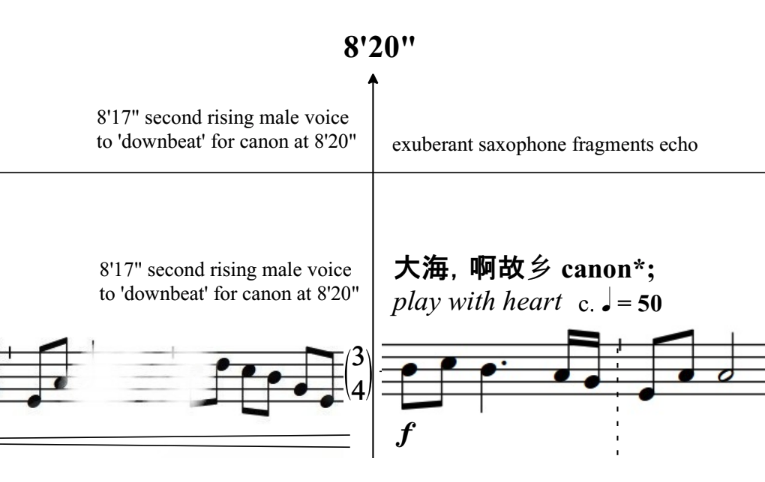
At 8'20"
the saxophone quartet is told to ‘play with heart’. Can you hear it? Like a heart breaking, but only from swelling too large. Like the way saxophone soloists lean back slightly at the height of a melody, as if the weight of the music is too much. Can you hear the history of this moment? The aunt carrying a crying toddler for twelve hours on a plane; Saturday music lessons since ten; a child writing in with coloured pencil note names they’ve forgotten; late-night orchestra rehearsals in a musty high school gym; a mother’s patient applause at every drawn-out student recital; moving to Melbourne for university and one day hearing a saxophone busker playing a famous Chinese song, longing for the ocean and for home; recognising the melody from singing in a children’s choir every Saturday ten years ago…
9'20"
Slowly, the song dissolves into breathy air tones, as if a melody lost in the wind. You watch the alto saxophonist step forward. You conjure a soft spotlight for her moment, and she plays one last melodic line; freely, and with homesickness.
Soon, there is only the sound of soft, whistling harmonics and air from the saxophones, like the ocean-noise you hear when you place your ear to a shell.
Soon, there is only the sound of soft, whistling harmonics and air from the saxophones, like the ocean-noise you hear when you place your ear to a shell.
return to the family table (9'45"–12'00")
Is that the sound of your mother in the kitchen again? You remember the sleepiness you felt as a child on summer holidays. You laid down in your room after having a big family meal, perhaps it’s Christmas, or one of those sunny, blurred-together days before New Year’s when there’s nowhere you need to be, nothing you need to do. Your bed sheets are warm from the afternoon sun. You hear the sounds of happy chatter in the next room, the clinks of dishes. You are half-asleep, half-awake, between worlds.
Can you hear the slurps of tea and the crunch of sesame seeds? Jiu Jiu, Mama and Yima gossiping?
Can you hear the slurps of tea and the crunch of sesame seeds? Jiu Jiu, Mama and Yima gossiping?
‘Aa, nei ge bei ne? Nei mou jam caa?’
(Ah, where’s your cup? Are you not drinking tea?)
‘Zhe ge gei Xiao Le’
(Hand this cup to Xiao Le)
‘San ge bei’
(...three cups)
‘Xiao Le chang yi ge zhe ge, zhe ge ya chi bu hao bu neng chi… ying de hen’
(Xiao Le, try this, but if your teeth are bad you won’t be able to bite it!... It’s so tough…)
‘Mei you na me ying ah’
(It’s not that tough)
‘Zhe ge hao chi o’
(This is yummy);
‘Zhe ge hao chi ma? Zhe ge hao chi’
(Is that yummy? This one is yummy!)
‘Zhe ge hen ying’
(This is tough!);
‘Zhe ge hen gui’
(This is expensive!);
‘Bu hao chi’
(But it’s not yummy)
‘O, hao suan!’
(Oh, it’s so sour!)
‘Hai yao fang shui zhu ma?’
(Do we need to boil more water?)
‘Gau laa, gau laa’
(No, we have enough to drink here)
12'00"
fine.
Now imagine this without the text...
Xiaole Zhan (詹小乐) is a Chinese-Aotearoa writer and composer based in Naarm. Their work features in Auckland University Press’s New Poets 11. They are the 2024 Kat Muscat Fellow, the winner of the 2023 Kill Your Darlings Non-Fiction Prize, and recipient of a 2025 Creative New Zealand Fellowship and 2025 Red Room Poetry Varuna Fellowship. Their name in Chinese means ‘Little Happy’, but can also be read as ‘Little Music’.